Thursday, August 25, 2022

A Series of Fortunate Events

Event #1:  1963 - 17-year old brand spanking new high school graduate - straight "A" student in Naivete' 101 (Actual GPA was 2.0 - I didn't deserve it).  Parents signed for me to join Air Force.  While in basic training, was tested and selected for Defense Language School in Monterey.  Filled out forms for security clearance and omitted arrest and conviction at 15 for "driving car without owner's consent."  Shortly after, was sent to technical training to become public health technician instead.  While processing into the school, was handed my records folder to take to another check-in point.  Peeked in folder and noticed they had discovered my omission about getting busted. Yet, they waived a "discharge for fraudulent enlistment." Went on to serve four-year commitment and left service at age 21.  Great adventures and great way to grow up...some.
Event #2:  1967 - Back home after first hitch, Seattle seemed too small.  Not happy with work opportunities. After a few months, re-signed with Air Force.  They wanted me to go to Intelligence school so I filled out another security clearance questionnaire and this time, listed my arrest at 15.  It worked. I got a Top Secret SCI clearance and went through Photo Interpreter and Combat Intelligence training at Lowry Air Force base, Denver Colorado.

Event #3:  1969 - Met and married Julieann Marie Thomas to begin 53-year plus relationship.  Be still my heart. Also assigned to Utapao Royal Thai Air Force Base, Thailand where I built strike charts for B-52 bombers.

Event #4:  Promotions were slow (it was probably me) and, after being selected for second tour in Southeast Asia within one year of return to States I was allowed to decline the assignment.  This meant I was ineligible for promotion and was due to be discharged from the service.  Air Force promptly promoted me by accident.  I was set up for nice potential bonus so I asked to withdraw my declination statement and volunteered to return to Southeast Asia.  It worked, I reenlisted and I promptly went back to Thailand (Udorn Royal Thai Air Force Base) where I worked as a photo interpreter picking out targets for air crews. 

Event #5: Passed College Level Entrance Program tests and was almost a sophomore before I took actual college classes (probably learned something from my love of reading...in spite of myself).  Began night classes in Thailand, continued them in next assignment and when I got close enough, I requested full time college under the Air Force's "Bootstrap" program.  Was selected, and we moved from Phoenix to San Bernardino where I completed Chapman College in ten months of night school then back again to Phoenix.  Yes it was fast... three and a half years start to finish. 

Event #6: 1973 - While back in Phoenix after graduation, I found out the Air Force Education folks had failed to have me acknowledge 3:1 payback time for Bootstrap education so I could leave quickly if I wanted. My third (gulp!) hitch, more than half way through a career, was almost up. It would have totaled 12 years; first four goofing around, second four settling down and third four finally getting serious about education. Then I was free to pursue any direction.  

Event #7: I had enjoyed my time in the Air Force so I applied for a commission in the Medical Service Corps. I had decided if that didn't work I would leave and perhaps pursue an MBA.

Event #8: 1975 - While home on leave, an Air force pal tending our Phoenix home called and said I had received a letter from the Medical Service Corps. He asked if I wanted him to open and read it to me. I said "yes" and in front of Julieann, my folks and brother he read the letter notifying me I had been selected. To receive that terrific news in their presence was pretty amazing.

Event #9: While at first assignment, I heard of opportunities to pursue Air Force sponsored Master's Degree in Healthcare Administration.  I asked around and a more senior officer told me; "I applied three times and got selected the third time."  I figured I had better start my three attempts then and applied right away.  My timing was good, I got lucky and was selected...first try.

Event #10: 1979 - Finished Master's program (fortunately) at Medical College of Virginia then assigned to Strategic Air Command's Fairchild hospital in Spokane, Washington.  Son Tyler Thomas was born there... in that same hospital. Julieann followed me to work to have our baby.

Event #11: 1980 - Boss at Fairchild, venerable Colonel Paul McNally had to leave for several months of Air War College and picked me to serve as temporary hospital administrator in his place.  Following visit by Strategic Air Command senior staff, Colonel Gottlieb and company, I was invited to assume Administrator job at northern Michigan hospital.  We had been at Fairchild less than a year.  I asked Julieann what she thought and didn't need a verbal response as I noticed tears in her eyes...not of happiness. I regretfully turned it down.  A few months later, right at our first year anniversary there, I was again offered the Administrator position, this time at the Air Force hospital in Great Falls, Montana. Julieann then held back the tears as I am pretty sure she knew how much I wanted that job. Son Tyler was right at a year old when we left Spokane. Julieann loved Spokane and the home we bought there. It was but one of many hardships she successfully faced during our career of moving really fast from place to place.   

Event #12: 1984 - As I approached the average 3-4 year tenure at Great Falls, Father's health was failing and I applied for a humanitarian assignment to be closer to family in Seattle area.  Found out conditions didn't qualify but MSC assignments officer (thank you Colonel Rutledge) relented and let us go anyway.

Event #13: After a few months in Seattle area and while visiting at parents home, I got a call from my former commander in Great Falls.  He asked if I "was sitting down."  I said "Yes" and he proceeded to tell me I had been promoted to Major three years below the primary zone, an event that occurred for Air Force officers approximately one percent of the time. I was actually nearing 20-year eligibility to leave the Air Force then but could not resist the promotion.  Pretty astonishing event and I would soon find out how huge a part luck had in it.

Event #14: As we approached one year in the Seattle area, I was interviewed for a job assisting with Medical Service Corps assignments and career development.  We moved to San Antonio, moved into a beautiful Spanish-style home on the base and over the next three years I loved working for and with the great Lieutenant Colonel Paul Murrell on career development and assignments for the 1,200 active duty Medical Service Corps officers stationed all over the world.

Event #15: While there I also gained real time experience concerning officer promotion boards. I learned in any single board, there might be a handful of officer records that senior selection committee officers would focus on for potential one, two, or three year early promotion. The few, the small percentage selected would be from that group and the decision was made on all factors available with the exception being the persons being considered were not actually present.  Performance reports (typically "fire walled" and pretty much perfect); education (military and civilian); and increasing job responsibility were key. Also, a current 8x10 photo. I figured officers could position themselves near the very top by focussing on those factors and from that point, it was a coin toss. I knew full well the good fortune involved and soon incorporated that information into career development briefings for fellow Medical Service Corps officers world-wide. Working title; "Aim high and get lucky." 

Event #16: 1987 - Nearing the three year point of that assignment, I started considering next steps. I applied to again be a Hospital Administrator as I loved the work. I was accepted for the position at the Ellsworth Air Force base hospital near Julieann's home town in South Dakota.  I was grateful for that and was once again left with a decision to take that job or retire from the Air Force and explore health care administration positions in the civil sector.  To help us with that, Julieann and I separately listed what we felt were the top ten good things we anticipated from leaving or staying.  Surprisingly, the results were very much the same.  Not long after, I considered that I had spent more than half my life to that point in the Air Force and it was time to find out what civilian life was like. I know I was pushing my luck but "aim high" right? Julieann agreed and we left.

Event #17: 1988 - Daughter Samantha Marie was born about a year after we left the Air Force.  I enjoyed telling folks I misinterpreted the meaning of leaving the Air Force to "start a new life."

Events #18-22:  1988-2023 - I watched my son and daughter grow and prosper for more than 40 and 30 years respectively and they continue to this day. I had another satisfying career as a consultant, most with my own corporation. With Julie's encouragement I bought a Harley Davidson and went through four of them in a 20-year span. I got to love, and learned to play hundreds of Texas Hold'em poker tournaments. I was able to write a couple of books focussing on memoirs of family, motorcycles and life's good fortune. The two are soon to be condensed and edited into one memoir, "Hayseed." 

So there you have it.  I have a wonderful family and I have all these events loaded in my bucket. Of course a lot went on before and hopefully a lot will go on after but this series of fortunate events continues to dazzle me.  As Julieann has often said; I have had a "charmed life" and the most fortunate event of all is that she has been with me, she has encouraged me at every step and she has motivated me to live it.


Tuesday, June 28, 2022

The Fisherman and His Daughter


As he progresses through his 77th trip around the sun he recalls:  

He was in a deep sleep.  The bedroom windows were open to let in the cool night air of the Black Hills of south Dakota.  Nearby, the waters of Rapid Creek provided a peaceful refrain of night noise.  Then, a slight beam of morning light crossed over the creek and entered the bedroom from the East.  As soon as it brushed his eyelids he woke, excited to meet the new day.

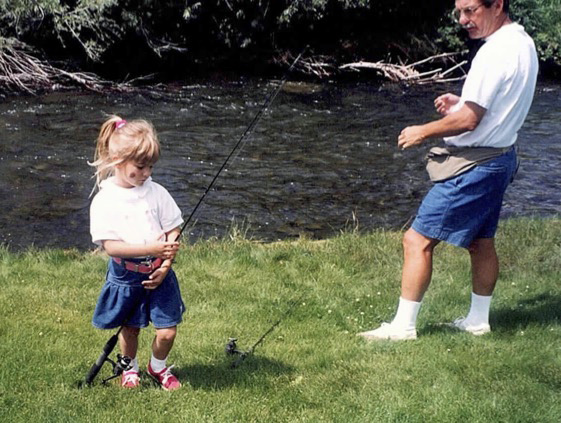
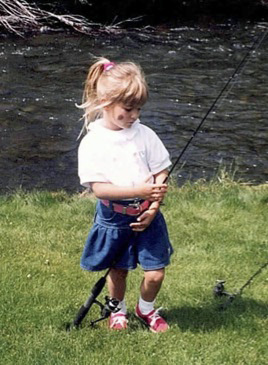
Sam at Rapid Creek, SD

He slipped gently from the bed so as not to disturb his wife.  After donning shorts, t-shirt and tennis shoes, he worked his way into the kitchen and passed through without stopping.  He carefully opened the door to the garage and in there, grabbed the small container of worms, his backpack with fishing tackle and his ultra-light fishing rod.  He proceeded outside and, while most in the Hills were still asleep, walked the hundred yards to the creek's foot bridge his father-in-law Casey had built.  After crossing over, he moved a few feet upstream of the bend in the creek that preceded a hole he had previously identified.  There, he set up his rod, baited his hook and tossed the bait into the stream above the hole.  As the small sinker and bait bounced downstream and moved over the hole, it attracted the attention of several rainbow trout who were waiting there for breakfast to float by.  One moved quickly to grab the bait and soon disappeared into the hands of the fisherman.  

Sam and Dad setting up tackle.
The fisherman repeated the same routine a couple of dozen times over the next hour and eventually held a stringer with eight pan-sized rainbow trout.  He packed up and returned to the house with his fishing tackle and his catch.  There, the family was up and about with their morning coffee and juice.  Casey, his Father-in-law, was preparing home fries and eggs to accompany their fresh trout breakfast.  

His daughter, Samantha Marie was four or five then and he asked her if she would like to try fishing.  She did and they did, across the bridge at that very same hole in the creek bend.  The next morning, she caught her first fish ever.  It was a perfect time in South Dakota's Black Hills...a time he would never forget.   


Monday, April 25, 2022

Foxholes and Cognac

The D-Day landing on Omaha was chaotic. He hit the beach and immediately started digging a foxhole. Just as he was finishing, another GI jumped into it.  So, he started another hole and yet another GI jumped into that! He then moved forward and took cover behind an anti-tank barrier. A German artillery shell landed close by, he glanced back and the two holes he had dug were gone, along with the soldiers who had occupied them.

A few days later, they were approaching a French village they believed had been given up by the Germans. They suspected there was cognac stored in villager's basements and they wanted to get theirs before the officers did. So, they commandeered a couple of jeeps and went into town.  As they were preparing to leave, one of the teams came out of a basement and saw a line of Germans standing at attention. They wanted to surrender but the NCO's did not want to escort them back to American lines because they didn't want their cache of cognac discovered. So, they loaded up the German's weapons, told them to walk 20 miles "that way" and headed back to camp with the German weapons and some mighty fine French cognac.

And that's the way it was for then Army Private Zaragoza Munguia.

Experiences of Alonzo Munguia's father - Zaragoza Munguia. He would remain in the Army and retire as Sergeant First Class.

Saturday, April 23, 2022

What Goes Around

The ROTC grad and future MSC began his Air Force career in 1964 trained as a transportation officer.  His first assignment; Hahn Air Force Base Germany.  For his first duty he was incorrectly assigned as an Aerospace Ground Equipment Officer.  The shavetail lieutenant figured his job was to step up no matter the assignment so he did just that.

One night, a shakedown inspection was scheduled in the enlisted dormitory and the shavetail was surprisingly selected to be part of the team.  It had rained a few days before and in his haste to get to the enlisted dorm the Lieutenant had left his rank on his raincoat. He arrived for the inspection without any rank on his blue jacket.  The accompanying first sergeant reassured him that he would cover for him, they were assigned a floor to inspect and they proceeded.  

Sometime prior to that night, the lieutenant's mother had given him a magazine subscription as part of his college graduation present.  The lieutenant hadn't given it much thought but on the night of the inspection it abruptly came to mind.  In one of the rooms, he looked down on a stack of magazines and saw that they were addressed to him. It turned out the airman, a staff sergeant, was a postal clerk and was regularly stealing magazines addressed to others.  The team wrote up their findings in their report to the commander.  The sergeant was busted two ranks with one suspended and ended up an airman first class.

Colonel Collins E. "Hugh Smith
USAF, MSC (Ret)
Cam Ranh Bay, Vietnam, 1965
Six years later, the lieutenant had successfully completed a line transfer to the Medical Service Corps and was a Captain.  He was assigned to Cam Ranh Bay Vietnam and as part of his in processing went to the Post Office to sign in.  There, he encountered the very same airman who he had busted years earlier.  The airman had made staff sergeant again and remained a postal administrative specialist.  There was a moment of mutual recognition and the Captain wryly stated; "Well, I guess I can kiss all my mail goodbye."  In response, the clerk said;  "No sir.  You are going to get the best postal service possible.  The clerk, in fact delivered on his promise as he upgraded all the Captain's outgoing mail to first class throughout their overlapping tours.

One night while returning to his room from the hospital, the MSC stopped by the post office to check his mail box in one of a series of small alcoves there.  As he opened his box, he heard something behind him.  He turned to see two Army soldiers staring at him.  One of them said; "Ain't never fragged an Air Force guy...got one now."  The other pulled a knife and said; "My turn." The other said; "Are you going to do it or not?" The one with the knife said; "I'm doing it now." The Captain was cornered in the alcove without an obvious escape route.  Just then, a nearby interior half-door opened, someone reached out to pull the officer inside the post office, slammed the door in their faces and the soldiers ran.  It was the very same sergeant...the one giving him first class postal service had topped it off by saving his life.

What goes around does indeed often come around...but not always in a way we might expect. Sometimes it becomes a notable, profound memory in a retired Air Force Medical Service Corps Colonel's career.    

Saturday, February 26, 2022

The Infantryman, the MSC and the .45

He was an Air Force Medical Service Corps Officer, a Captain stationed at Cam Ranh Bay Vietnam in 1971. As chief of administration, one of his duties included customs inspections for departing hospital ship patients.

The Captain stood at the severely wounded infantryman's bedside. He was assisting with processing the patient for imminent evacuation on a ship the next day. With some time remaining, he asked the soldier how he was injured. The soldier was lucid and could see everything that had happened to him.

"I was on a recon when the soldier in front me hit a tripwire that killed him. I quickly looked around and saw a figure running away through the bush. I chased him down and killed him. I found a .45 on him and headed back to my unit carrying the .45 with me. As I was returning, I hit another trip wire that blew off my legs and arms.

Colonel Collins E. "Hugh" Smith Jr., USAF, MSC (Ret)
Cam Ranh Bay, Viet Nam, 1971
The Captain explained he was the customs inspector and asked the soldier if he had any weapons or narcotics with him. The soldier said; "Yes Captain. There's a .45 right in the middle of my back." The MSC said; "Will it be okay if I turn you a little and take a look at it?" The soldier agreed. The MSC said; "Please tell me it's unloaded." The soldier assured him it was not so he then gently lifted the soldier's shoulder revealing the .45 underneath.

The MSC removed the clip and inspected it and the chamber. Finding both empty, he then said; "You know you can legally go home with this as a war souvenir. I can run over to my friend the provost marshall, get it attested for you and be back within 5 minutes."

The soldier said; "No, you keep it.  I am not going to make it." The MSC noted the soldier's contact information. After a week or so, the MSC called the soldier's home. He offered to get the .45 shipped to the soldier but the parents told him to just keep it. Their son after all, did not make it.

After thirty-one years, the MSC retired as a Colonel having served as a Director of Base Medical Services at three facilities for his last 10+ years.  Today, more than 25 years post-retirement, the Colonel still softly tells the story with a deep, abiding sense of love and respect for the infantryman with the .45. 


Wednesday, February 9, 2022

Sweating Bullets

There is probably not a military health care administrator alive who hasn't had a "Staff Assistance Visit" or worse yet, Inspector General visit.  They may be known by different names these days but what they basically are is administrative 'strip search' inspections by higher headquarters staff.  They (meaning a team of functional and management experts) come to take a close look at your programs and make suggestions on how to improve them...or so they say.  While that is mostly the truth, it also true that they will send you packing if you are not doing a good overall job.  

"Not a problem," a Medical Service Corps officer might say to him or her self; "I am doing fine."  But then, you can never be completely sure as you probably carry a half dozen or more hats including some you may not even be schooled in.  Then again, if you are the head administrator, you have four or more MSCs working for you and that drives the number of "hats" into the dozens so you don't know exactly how you are doing either.  Plus, that person inspecting you may have a totally different take on whether you are doing fine or not right?!

So there we were, in the mid-70's at Mountain Home.  A handful of MSC's and a couple hundred health care workers preparing for a Tactical Air Command Staff Assistance Visit headed by none other than the late (RIP) Colonel Emmett Thornell (the Alligator" as he was sometimes called).  Charlie Brown, then a Major, was our Administrator and we were mostly shavetail lieutenants trying to figure out how to do our jobs correctly.  Charlie was a "below the primary zone" administrative whiz who had a lot of written and verbal program advice for us and we were hauling a__ to get ready for the visit as a previous one with a different crew had not gone well.  As his nickname suggested, Colonel Thornell had a tough reputation. As a brown bar I'll confess that I (and maybe some of the others) was pretty intimidated.  

Lt. Charlie Brown
Viet Nam

The visit hit, we did well and I think everyone up to and including the wing commander breathed a sigh of relief.  Charlie set up our next objective for the following weekend...four of us, the "Riders of the Purple Sage" agreed to participate.  There were others invited but I suspect they didn't relish the idea of camping with us reprobates.  Charlie the hospital administrator, Jack Ohl the box kicker, Jerry Salsberry, technical box kicker and I, the resident bean counter headed out for Idaho's Strike Dam for the weekend.  Accompanying us were a recent model Winnebago RV (Charlie's), a Crestliner ski boat (mine), a bunch of easy-to-prepare food including some venison tenderloins and an abundance of beer. 

The trip was just for a day and night but "Oh, what an night" as the song goes.  We had a blast skiing that day and didn't hurt anyone including ourselves. That night we played music, sang at the top of our lungs, arm wrestled and laughed at anything that had the slightest resemblance to a joke.  Far into the night, as the four of us attempted to sleep, one or more would break out in laughter over a comment by another.  Quite a few times, we would begin laughing with absolutely no prompt.  I had never laughed so hard or so often in my life until then and have not laughed like that since...not even for my own subsequent IG and Staff Assistance visits when it was my turn to serve as hospital administrator.

You've "been there and done that" haven't you!? Great memories eh?!  

Tuesday, January 11, 2022

M-M-Motivation...

Motivation...Why hast thou departed?

Worry - 

Wife &
Daughter &
Son &
Congress &
Pandemic 

The sum of it all - 

Sleep deprived
Since 2016 election
And some before.

Will it return? -

Motivation that is.
Or is it bound
To gather dust
On the shelf
Of faded memory?

Time works against -

The September 
Or later
Of my years
Looms.

C'mon Tom...snap the fuck out of it and getchu' summa that...motivation that is. 

Saturday, January 1, 2022

Passages - "A Promised Land"

In all my life.  

In ALL my life, through reading thousands of books, fiction and nonfiction, I had never freely marked passages in books.  Sure there were plenty of marks and yellow highlights when I had to force memorization and comprehension under the threat of later testing.  Yet, I had never done it because I was so impressed with what I was reading.  I had done it at times in all schools including graduate school but never because I really wanted to.  

Until this:

As it seems most politicians do, along with those most closely connected with them, the 44th President of the United States, Barack Obama wrote a book.  It's title "A Promised Land." It is clearly written, humble and somewhat long at slightly over 700 pages. It is a fine, educational read, even for those who have no particular interest in how our government operates...kind of like me for most of my adult life.

Using yellow stickies, I marked nine passages I wanted to commemorate for later reading and reflection. Rather than include the complete passages here, I am going to list their beginning page, topics and add my 'two cents' as I go:

  1. 243 - The Filibuster - Our ability to vote and to have it count (Democracy) is hanging by a thread today.  The Freedom to Vote Act will not pass unless we circumvent the filibuster.  It's that simple. The fact that almost half our Senators will vote against it is a damn shame.
  2. 275 - The Social Contract - Many politicians and most of the wealthy who take pride in avoiding taxes fail to consider that all government services, right down to the very highways they travel on are a collective financial responsibility.  We are all in this...except them.
  3. 374 - Universal Healthcare - At some point we all pay anyway - in indigent care, in Medicaid, in Medicare and so on.  If we had this, our poor and uninsured would not delay needed care and would have a lot fewer chronic or intensive care (read more costly) conditions.  There are tons of sensible arguments in favor and none of those opposed make sense. It's a humanitarian, AND a financial thing comprende'? 
  4. 424 - The Affordable Care Act - All opposed said; "At 20,000 pages it's wrong."  As it turned out, it was and is right. Sure there were things that had to be fixed but in the end, it is right.
  5. 446 - "Whatever you do..." - "Whatever you do won't be enough.  Try Anyway." This is Barack's quote and he kept after it in spite of Mitch's chronic obstructionism.  Remarkable.
  6. 496 - Cost-benefit Analysis - Yes, in politics this fundamental process is too often overlooked - the example I appreciated most was the reduction in costly trucker regulations.
  7. 534 - Management - Management by walking around.  He loved it and I love it. It should be emphasized in Management 101 at every college.  
  8. 638 - Samantha Power - I'm a huge fan of her intellect and beliefs, as is our former President.
  9. 698 - Geronimo - Osama bin Laden.  Sure we got him under Obama's watch.  But early on we lost our way in some respects.  We started our longest war. We started an Orwellian Department of Homeland Security. We drove moderates to hard-line immigration resistance.  We stimulated general hatred of Muslims.  This list is not complete and we are definitely not a better nation for it.
Now there.  American non-fiction at its finest.  If you have read it, you know what I mean.  If you haven't read it but will, you will be on a great adventure.  If you never do read it, that will be your loss and I am sorry.


Sunday, November 21, 2021

The P.I.M.P.

Once upon a time, I was walking through the parking lot at our local grocery store when a black man who was watching me said; "Hey man, did you hurt your leg or is that your pimp walk?"  I laughed and said; "Both!"  Yes, it is a gimp right leg I've been hauling around for a lot of years but it doesn't hurt. Probably just a nerve or something.  When asked about it outright I typically reply; "It's my sympathy limp." and that is good for a laugh.

This is about a movement that is not gimp leg related though...PIMP is an acronym for the Pushup Institute of ex-Military Personnel, hereafter known as the "Tute."  As such, the Tute has promulgated certain guidelines for pushup completion that naturally changes as a person progresses toward septuagenarian status and beyond;

1. Age 0-15 - none expected - just crawl baby crawl

2. Age 15-45 - elbows at 60 degrees, face in the mud, straighten up then repeat

3. Age 45-70 - elbows at 45 degrees, huffing and puffing permitted

4. Age 70+ - elbows at 15 degrees, smelling salts to begin, or if you are a politician, adderall.  Prayer recommended. Also recommended; Rescue personnel standing by to help you to your feet.

Okay, okay I made that all up but hey, it is elder entitlement to just make things up right?!

Anyway I did it and here it is...the 2021 winner of the official P.I.M.P Institute Badge of Merit.  Click on that puppy...

76@76


Sunday, November 7, 2021

Dear United States Air Force Medical Service Corps,


This morning, I read this fine article written by Bill Murphy from the New Yorker magazine about Sam Watterson, creator of the "Calvin and Hobbs" comic strip.  It was Watterson's letter written to "Dear Reader" in 1995. In it, he announced his resignation to take on other projects...to pursue other dreams.

Reading it stirred my tendency for gushing sentimentality concerning my tenure with the Medical Service Corps.  You see, I left the Corps also..."to pursue other dreams." This, in turn, prompted me to write a similar letter in what may well be an awkward but nevertheless sincere imitation...

Dear Medical Service Corps Officer,

This is to announce my departure from the Air Force and the Medical Service Corps after serving equally as airman and officer for 24 years.

When and if you read this, I will have been retired from the Corps for more than 30 years. So yes, I am really late here. Yet, in that time, I have remained in touch with many, though regrettably not all, fellow officers who I served with and admired. I know I should have written this then and I apologize.  Even though you do not expect it, I want you know how much you meant to me and what a large part of my heart still belongs to you.

Julieann Marie Campbell
Spring, 1987, Air Force Spouse
of the Very First Order.
I am keeping this letter painfully short although it could easily be book length. In fact, elements of my Air Force life comprise  large part of the memoirs in my book "The Hayseed," a tribute to an amazing and most fortunate life. 

I just want you to know I miss the camaraderie and common causes you have. For you and most of your fellow officers, I hope and believe it is something you will cherish until the end of your days.

I left simply because, after joining our Air Force at the tender age of 17, I was curious about what a life would be like if I was free from the cycle of geographical and work assignments. Yet, I loved what I was doing in supporting patient care for the military and their families. The fact is, I still miss it to this day.

Things have gone very well since. No complaints here but I want to say I loved serving with you and would have been honored and happy to serve with you well beyond my 24 years.

I wish you the very best Ma'am, and Sir as you serve, or have served with such fine people. I sincerely hope you eventually find your heart filled with the love and memories you will experience with the Corps.  And when you choose to end your time, maybe you will remember...maybe you will write a letter to those you served with. 

Until then, as our first soldier, George Washington wrote in abbreviated fashion; I remain "...Your Most Obedt and Affectionate Hble Servt."


Wednesday, November 3, 2021

"CHAMPS'R'US"

It was 1988 and that's what it said on the sweatshirts he designed as motivation and Christmas presents for the staff of Foundation Health Plan; "CHAMPS'R'US." Foundation Health was the winning (only) bidder for a new, massive government health care contract.  The designer was a recently retired Air Force Lieutenant Colonel line officer who was working in our newly established corporate marketing department. He was part of a massive roll out of a Department of Defense demonstration project called the "CHAMPUS Reform Initiative" or "CRI" (Today called TRICARE) It was a test of a triple-option health care health plan that was designed to supplement the military health care system with providers who would deliver health care to nearly a million eligible members throughout the western US.

A commemorative contract award
plaque and the world's largest name tag.

In 1987, I had recently retired from the Air Force and was rotating among Foundation Health Plan departments to learn the HMO ropes when we won the contract. I was at Foundation courtesy of a recommendation by fellow Medical Service Corps officer and friend, Bob Bunker, Bob had recommended me to a colleague of his, Dr. James J. Schubert. As a result, I was flown to Sacramento, met with the doctor and his staff and was hired.

Some time earlier, Bob had met with Dr. Schubert and company as part of his Air Force Medical Service Innovation Department activities.  Bob had piqued Foundations interest in expanding their health maintenance organization activities to cover the medical needs of Air Force families with health care needs that were beyond the capacity of active duty providers. Dr. Schubert had 11 years military medical experience as an orthopedic resident at Walter Reed Army Medical Center and practicing surgeon. The two quickly found common ground in their military family health care interests and the potential for a health plan that would complement medical facilities serving those families.  This formed a thread that would pull together a succession of events that would culminate in the first CRI/TRICARE contract.  

Foundation was established as one of the first federally recognized companies under the HMO Act of 1973.  It was something new and interesting to me and I was happy to be learning under the tutelage of one of its founders, Dr. James J. Schubert and his expert staff.  

Then, I was fortunate to be named COO for the Northwest portion of the CRI contract, serving almost 400,000 beneficiaries and their supporting MTFs... mainly because of my military health care background and certainly not because of my managed care knowledge. The southern part of California was to be operated by a subcontractor to Foundation. 

We were given just six months to hire and train the staff needed to perform the contract requirements and a lot of new folks were pretty burnt out.  The colonel thought up the "Champs R US" expression in a spin off of the famous "ToysRUs" company name and had it printed on sweatshirts for all the staff. It was a small bright spot in an otherwise difficult time.  All in all though, we were extremely lucky and hired some terrific people.  

I do recall one dark moment in our hiring process.  We had been at it for a few weeks and we needed nurses for our advice lines, utilization management and satellite offices near MTFs.  We had an open interview one Saturday morning and when I walked through our lobby I saw a bunch of them waiting to be interviewed.  My first reaction was a sense of disappointment that our healthcare system would attract nurses away from patient bedsides. It was my old hospital hat kicking in I guess but I couldn't help but wonder why we, as in all of us, couldn't do a better job of retaining them in direct health care.

Plaque reverse side -
Copy of the actual contract award
As you might suspect, just getting to the implementation of CRI involved hundreds if not thousands of chance occurrences. There had to be an operations catalyst like Bob Bunker to link key parties of interest. There had to be an Assistant Secretary of Defense for Health Affairs (William Mayer, M.D.), supported by Colonel Fred Vago and Lt Col Dave Fant, both Air Force MSCs and a host of others who had the vision and support staff needed to design a workable request for proposals.  There had to be an HMO Chairman of the Board, another MD (James J. Schubert) who also had the vision and support staff to see the possibilities first outlined by Bunker. Doctor Schubert had also done his Orthopedic residency at Walter Reed and felt closely tied to the Military Health System. 

Finally, there had to be what was called a "risk management corridor" to spread the rewards if it worked and limit the losses if it didn't.  There was so much money and so many lives involved that failure meant many jobs and an entire company would likely be lost.  More importantly, a program to improve military family access to quality health care at a reasonable price would be lost. Before the risk corridor (which I believe was thought of by the Foundation actuary) there were several HMOs nationwide who had interest and all but one had dropped out over concern for ambiguities in the program including enrollment projections, sharing resources with the military and most important to them... the potential for significant financial losses.

The contract technical proposals themselves were 12 volumes of individual 3 inch binders, all with matching binders of attachments covering such major topics as contract management, provider relations, utilization management, implementation, claims, resource sharing, finance and on and on.  Somewhere between 6-9 sets were to be submitted as I vaguely recall and of course, there had to be at least an equal number of sets retained for internal use. Just performance of the actuarial work on available data needed for substantive estimates on factors including enrollment and utilization alone could easily run a couple of million dollars. There were, again, hundreds if not thousands of moving parts to the project and it is very likely none of the parties knew them all.

For example; just imagine putting together a full service provider network using newly trained hires to convince docs and hospitals to sign up to deliver health care at a price significantly lower than they were used to...for a million people give or take.  Then build a claims system that would adequately handle the results.  Well, the first worked pretty fair but the second; claims, was a disaster. The fact is, an entire lengthy book could be written on the failure of the "Eagle" claims system alone.  But those are stories for another time and someone much more knowledgeable than I. Blend in some utilization management (a review and denial system) that the docs hated and throw in some rigid quality assurance for good measure.  While you are at it, convince and reassure MTF commanders and military families they were being well taken care of..."those moving parts" right?! 

The up front hiring was set at a frantic pace and there were government monitors everywhere.  DOD had a full-time rep (then Major Don Palen, another AF MSC) on site to watch for things that were broken. There were frequent visits and meetings held at various headquarters and health care facilities throughout the Western US and Hawaii.  In the end, CRI opened its doors for business, suffered setbacks but eventually worked out. It was blessed by an external, independent review from Rand Corporation and over time was expanded to became known as TRICARE. TRICARE has continued for more than thirty years, serving over nine and a half million beneficiaries world-wide.

Note:  There are probably a bunch of mistakes in this account and they are all mine.  Memory doesn't always serve you know?!